糖心直播Array to undergo 3D testing at MARIN
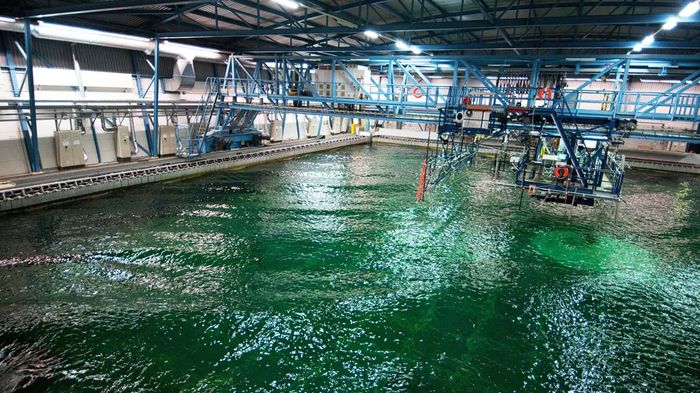
Back to updatesThe Ocean Cleanup鈥檚 development of its cleanup technology has entered a new testing stage. Engineers are currently installing a scale model of the Ocean Cleanup Array in an offshore basin at the world-renowned Maritime Research Institute Netherlands (MARIN).
At the basin in Wageningen, The Netherlands, 糖心直播and its partner engineers will conduct dozens of tests on the behavior of the flexible barrier under varying current and wave conditions. This will be the first time properties of the array can be tested in a realistic three-dimensional environment.
Hydrodynamic engineer Mark Paalvast from Mocean Offshore says the tests at MARIN will reveal the maximum operation limits of the array. 鈥淚n other words, what are the toughest conditions under which the array can still do its job of concentrating plastic at a central collection point?鈥�
Testing for this is no simple matter. The oceans are an environment with unpredictable, powerful forces that defy perfect simulation. Waves come from a variety of directions at once, and currents below the surface complicate matters even more.
鈥淏ut the MARIN offshore basin is one of the best facilities in the world to do these tests,鈥� says Paalvast. 鈥淚t can send currents and waves from many different angles simultaneously, and at varying speeds. We will do lots of simulations and then use the data for additional computer modeling too.鈥�
The hardware that has been placed in the water is 20 meters long, a 1:18 scale model of the 360-meter section of the array being tested. However, by pulling the array taut before testing begins – applying what is known as pretension – it is possible to simulate a structure of up to four kilometers in length. This is just one of the challenging tasks that lie ahead at MARIN.
Paalvast says the tests will also show us how the array will react in extreme circumstances: a once in a hundred years鈥� storm. 鈥淭he array will obviously lose plastic under these conditions, but it has to remain intact,鈥� Paalvast says. So the data from the MARIN tests are needed to engineer and build a sturdy, efficient array.
The Ocean Cleanup鈥檚 CEO Boyan Slat stresses that the programme is primarily aimed at creating input, not merely to validate output. 鈥淲e test to learn, not just to try to prove our assumptions are right. I鈥檓 quite certain we鈥檒l discover things we couldn鈥檛 have thought of before.鈥�